MEETINGS
August is Membership and New Club Development Month
| 8/14 |
General Meeting |
| 8/21 |
Lobbyist Jay Morgan, JL Morgan Company Inc. |
| 8/28 |
General Meeting |
BIRTHDAYS
| 8/13 |
Elma McCutchen |
| 8/17 |
Victoria Seals, PhD |
| 8/19 |
Jared Evans |
| 9/3 |
Uku Urb |
WEDDING ANNIVERSARIES
| 8/23 |
Richard Gerakitis (46) |
ROTARY CLUB OF
Atlanta West End
Fridays, 12:15 pm
Georgia Tech Hotel & Conference Center*
800 Spring St NW
Atlanta, GA 30308
LEADERSHIP
| President |
Christopher Hempfling |
| President-Elect |
Rodney Fields |
| Immediate PP |
Victoria Seals, PhD |
| Vice President |
Rodney Fields |
| Treasurer |
Melanie Sewell |
| Secretary |
Neil Shorthouse |
| Public Image |
CJ Stewart |
This Week's Program: Daniel Hardeman, Regional Developer of Big Dill, LLC
Friday, August 14, 2026

Friday, August 14 , the Rotary Club of Atlanta West End is pleased to welcome Daniel Hardeman, Regional Developer of Atlanta for Big Dill LLC, as our program speaker. An owner and board member of the company, Daniel brings a strong background in business analytics, project management, and team leadership, with particular experience helping organizations and people navigate change.
In his role, Daniel is leading Big Dill's growth in the Atlanta region, working alongside investors, local community partners, and metro Atlanta's pickleball community to bring new locations to life. His experience in cross-functional collaboration and international volunteer work has shaped a leadership style grounded in inclusion, cultural awareness, and genuine care for others. We look forward to hearing Daniel's perspective on leadership, growth, and how thoughtfully built spaces can bring diverse communities together.
KeyWay Report: Adrienne Langford
Ms. Bee Long, Director of AWER Director of Community Services, introduced Ms. Adrienne Langford a field representative for the Georgia Student Finance Commission. Founded in 1965, the GSFC has become one of the most successful state student aid operations in the nation. First created to provide loans, the agency progressed to state- and lottery-funded scholarships, grants, service cancelable loan programs and providing free financial aid consultation. GSFC's mission is to ensure Georgians have an opportunity to access education beyond high school. The Georgia Lottery in November 1992 and with it the HOPE Scholarship funding was created by the Georgia General Assembly through spirited leadership of then Governor Zell Miller. He led the creation Lottery for Education Act created the Georgia Lottery Corporation (GLC) to oversee and operate the Lottery. Since the GLC has experienced unprecedented sales and returns to education in its 34-year operation - with net sales reaching over $115 billion. Since its inception, the GLC has transferred more than $31.3 billion to the State Treasury's Lottery for Education Account
Adrienne Langford explained how the state of Georgia provides major postsecondary options for millions of students and accomplishes that on student-by-student through several major funding resource that frequently work in cooperation with federal government funds. These funds tie directory to AWER’s commitments to Booker T. Washington High School because they provide financial aid opportunities available to students in Georgia, particularly in support of the club's ongoing mission to assist students at Booker T. Washington High School in pursuing post-secondary education.
Adrienne defined key points in the postsecondary funding word beginning with:
- FAFSA: The Free Application for Federal Student Aid, is the single application that initiates access to both federal and state financial aid. It is a major point of entry into funding all students access to financial support. It and must be completed annually to access most sources of financial aid funding;
- GSF App is a one-time Georgia-specific application valid for 10 years.
- Cost of Attendance (COA): The total estimated cost for a student to attend college, including both direct and indirect expenses. Students and parents can more understand the full cost of attending college, which includes both direct costs (tuition, fees) and indirect costs (groceries, transportation, books). COA carefully estimated cost of college for every higher education institution in the U.S., which range from $10,000-$60,000 per year.
- HOPE Program: A Georgia lottery-funded scholarship and grant program encompassing five distinct funding programs for eligible Georgia students.
- Merit-Based vs. Need-Based Aid: Two primary categories of financial aid — one based on academic performance, the other on household financial need.
Note from Adrienne: She explained that students can receive scholarships and grants exceeding their cost of attendance, with the surplus returned to them as their own cash.
Types and Sources of Financial Aid:
- Scholarships and grants (free money, does not need to be repaid)
- Loans (available as a resource if needed)
- Work-study programs (federal and institutional)
- Sources include federal programs, state programs, colleges, professional organizations, private foundations, and employers
Federal Financial Aid:
- FAFSA - Completing the FAFSA does not automatically gain access to loans; additional steps are required to borrow.
- One application covers the Pell Grant (up to $7,395/year, need-based), SEOG (first-come, first-served for full Pell Grant recipients), Federal Work-Study, TEACH Grant (for education majors), and student loans.
- HOPE Program
The HOPE program encompasses five programs:
- HOPE Scholarship – Requires 3.0 high school GPA and 4 academically rigorous course credits. Pays 100% of the previous year's standard tuition at public institutions.
- Zell Miller Scholarship – Requires 3.7 GPA, 4 rigorous credits, and a 1200 SAT or 25 ACT (or valedictorian/salutatorian status). Pays 100% of the current year's standard tuition at public institutions.
- HOPE Grant – For students pursuing certificate or diploma programs (typically at technical colleges). No high school GPA requirement; must maintain a 2.0 college GPA.
- Zell Miller Grant – For certificate/diploma students who achieve a 3.5 college GPA.
- HOPE Career Grant – For students in 19 in-demand fields (e.g., including early childcare, construction, welding, computer programming, practical nursing). Can be combined with HOPE Grant or Zell Miller Grant to cover full tuition. Each of the 22 Technical Colleges of the Technical College System of Georgia are covered under the HOPE Grant and HOPE Career Grant programs.
Note: State financial aid can be used at eligible private institutions in Georgia.
Adrienne further noted that applications for postsecondary funding should be submitted early: last-minute efforts could derail an application. Most information for programs providing financial aid can be located at gafutures.org.
Agenda, Connections, & Four-Way Test
Meeting Agenda
- Call to Order
- Invocation & Pledge
- Introduction of Guests
- Tasse Trivia
- DEI Moment
- Announcements
- Program/Speaker
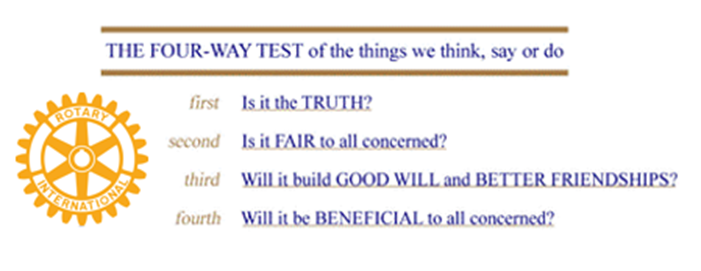
- The Four-Way Test
- Adjournment
Sign up to be a program chair in the new Rotary Year here today!
A Little Dues, A Lot of Good
Supporting District 6900 starts with staying current on your district dues. Keeping your dues up to date ensures we can continue providing leadership development, youth programs, district events, club support, and the many resources that help our clubs thrive.