This Week's Program: Reginald Beaty
On Friday, October 16 , the Rotary Club of Atlanta West End is pleased to welcome Reginald B. Beaty , executive leader, author, U.S. Army retiree, and President of The Foundation For Educational Success, as our program speaker. With decades of experience in organizational leadership, education, and youth development, Beaty has dedicated his career to strengthening schools, developing leaders, and improving student outcomes. We look forward to hearing his insights on leadership, educational success, and creating lasting community impact.
Reginald Beaty
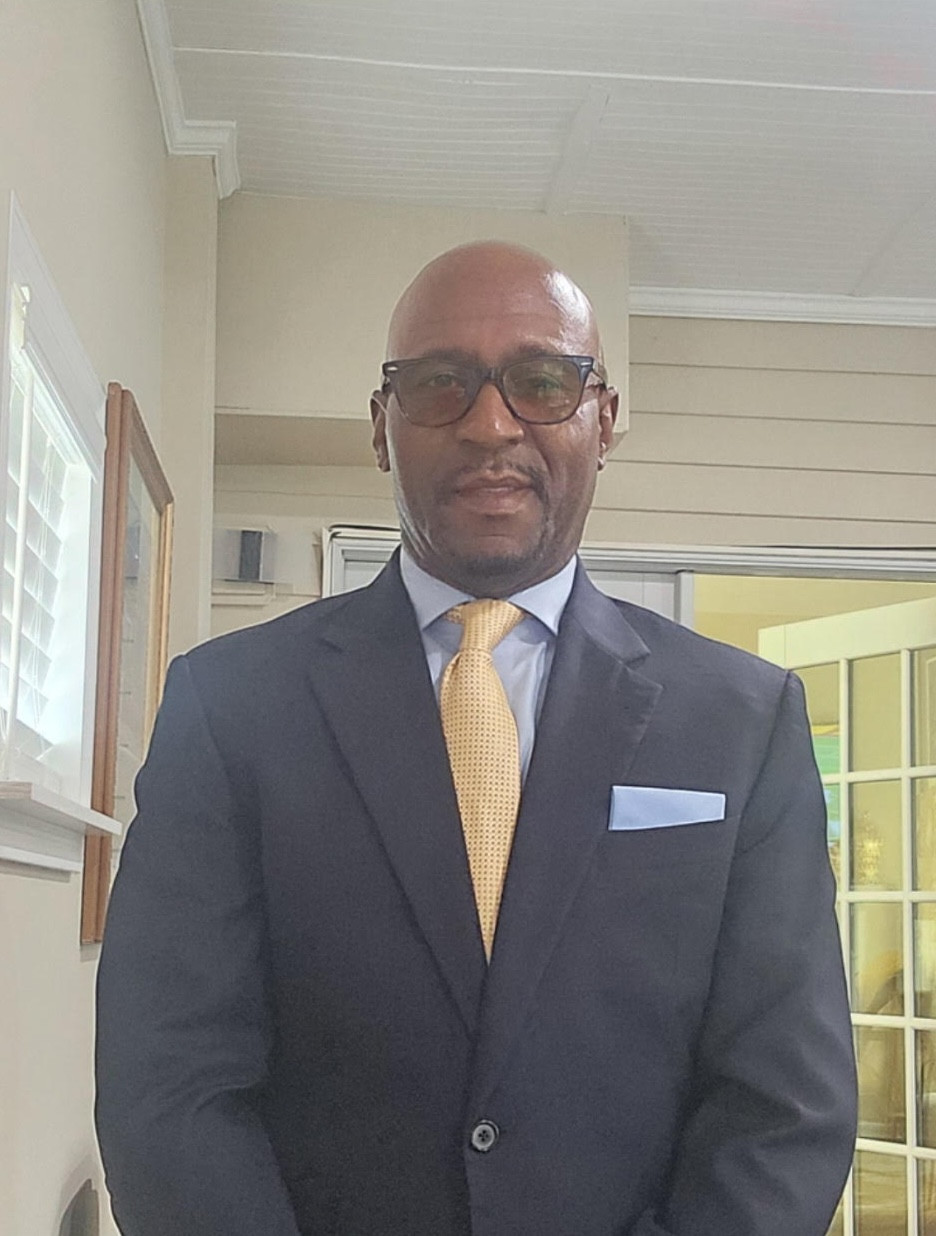
Reginald B. Beaty is a distinguished executive, nonprofit strategist, author, and United States Army retiree with a record of leading organizations through growth, transformation, and operational complexity. His expertise includes enterprise strategy, organizational leadership, operations, program management, leadership development, and education services. Across sectors, he has built high-performing teams, managed multimillion-dollar budgets, directed complex initiatives, and strengthened organizational culture and performance.,
Beaty has applied decades of executive and operational experience to advance leadership capability and organizational effectiveness. For over 25 years, he has also served as President of The Foundation For Educational Success, shaping strategies that strengthen school performance, student environments, and graduation outcomes. A recognized presenter on education, leadership, and youth development, he has trained more than 250 school and nonprofit leadership teams in high-performance culture and climate strategies and authored six books.
As vice president of operations at Paine College from 2014 to 2020, Beaty served as a strategic advisor to the president and senior leadership team on institutional operations, strategic priorities, goals, and execution. He led the college’s reorganization plan, supported the development of enterprise-wide objectives, and strengthened leadership capacity through targeted training and development.
Earlier, Beaty served as Executive Vice President and Chief Operating Officer of Communities In Schools of Georgia from 2006 to 2009. As executive director of Performance Learning Centers from 2001 to 2006, he led strategic and annual planning for 29 nontraditional high schools across Georgia while supporting national expansion. He helped develop, scale, and sustain 40 local affiliates; established business plans, marketing opportunities, training programs, and statewide implementation services, and managed a budget exceeding $6 million. His portfolio included alternative education programs supported by the Bill & Melinda Gates Foundation and the development of processes designed to improve teaching, learning, academic achievement, and classroom behavior. Additionally, he led a team that developed a statewide initiative (Graduation Coaches) on behalf of the Governor and Georgia Department of Education.
Beaty’s executive leadership foundation was established during his service as a officer in the United States Army. He commanded 2,000 troops, directed staff performance, and oversaw support, maintenance, and administrative functions. He also led professional development and technical training, managed an $80 million budget, and served as a tactical operations officer integrating personnel, intelligence, logistics, and unit movement. By redesigning battalion training strategy, he improved readiness, productivity, morale, and operational performance.
Beaty completed the Senior Nonprofit Management Course at Harvard Business School. He earned a Master of Arts in Aerospace Education from Middle Tennessee State University and a Bachelor of Arts in Business Administration from Stillman College.
JOIN ONLINE: Click Here| Meeting ID: 874 0116 4307 | Passcode: Service | One tap mobile: +13052241968
Atlanta West End Rotary Returns to Atlanta Streets Alive This Fall
Plus a Community Care in West End
The Rotary Club of Atlanta West End will participate in Atlanta Streets Alive again this October and November! Join us for two afternoons of neighborhood connection as Atlanta’s streets open for walking, biking, skating, and community fun.
Sunday, October 18: Ralph David Abernathy Boulevard
Atlanta Streets Alive returns to the West End to Grant Park route along Ralph David Abernathy Boulevard and Georgia Avenue, from 2 to 6 p.m. Explore the neighborhood and stop by to connect with Atlanta West End Rotarians. Consult the digital event map to plan your visit.
Alongside Atlanta Streets Alive, a community care event will honor the memory of West End neighbor Terence “Yohan” Cobbs , remembered for his generosity and kindness. Organized by the West End / Westview Interfaith Alliance, Self-Help Credit Union, and neighbors , the gathering offers our club another opportunity to support the community and put service into action. Everyone is welcome. Full event details and ways to help click here.
Sunday, November 8: Howell Mill Road
We’ll be back for Atlanta Streets Alive’s partnership with Westside Stride on Howell Mill Road. Enjoy an afternoon of food, music, and family-friendly activities while connecting with neighbors and community organizations. Visit the Westside Stride website for more information.
These events offer an opportunity to meet our members, learn about Rotary’s service, and explore ways to make a difference together. Bring a friend, enjoy the open streets, and say hello!
KeyWay Report: Honorable Roger Bruce
President Chris Hempfling welcomed all to the meeting and turned the meeting over to Neil Shorthouse AWER Secretary and AWER program chair of October who introduced our speaker, the Honorable Roger Bruce, former Georgia State Representative for House Legislative District 61 which is south of the City of Atlanta. Representative Bruce served for 22 years (11 consecutive election victories). The central focus of the meeting was Representative Bruce's address on the state of American democracy, the significance of the upcoming midterm elections, informed civic participation, and personal resilience in public service.
Representative Bruce emphasized major institutional bulwarks of the United States including
- Democratic accountability: The importance of maintaining the foundational pillars of democracy — the Legislative, Executive, and Judicial branches — along with a free press;
- Informed voting: The principle that voters should evaluate candidates based on qualifications and demonstrated ability, much like hiring for a skilled profession;
- Civic organizing: The power of strategic coalition-building and collective action to achieve legislative change, even from a position of limited authority;
- Humanitarian leadership: The idea that effective public service is rooted in genuine concern for people's well-being, not personal ambition or partisan loyalty;
- Intergenerational responsibility: The obligation to make decisions that benefit not only current citizens but future generations.
In light of the above he asked all present several important questions:
- Is America still a democracy?
- What is truly at stake in the midterm elections beyond partisan politics?
- How should voters evaluate candidates when choosing who to support?
- Can a single elected official realistically effect meaningful change for working-class communities?
- What keeps public servants motivated in the face of threats, personal hardship, and systemic resistance?
- How do we encourage young people who feel their vote does not matter?
- Community members should not wait for elected officials to solve problems; self-determination and organized strategy are essential.
Roger Bruce opened his remarks by posing a foundational question to the group: "Is America still a democracy?" He acknowledged that this question would have been unusual in a Rotary setting just five or six years ago, but argued it is now entirely appropriate given recent events. He asked attendees to set aside their partisan identities and examine objectively what has occurred in American political life.
He emphasized that the upcoming midterm election is not fundamentally about Democrats or Republicans, or even about individual candidates. Rather, it is about whether citizens choose to preserve the system of government they have known throughout their lives or allow it to drift toward an unrecognizable form. He urged attendees to vote in a way that reflects their genuine long-term interests — for themselves, their children, and their grandchildren.
Bruce acknowledged the younger generation’s frustration but urges young people to look at what surrounds them and ask whether they want those conditions to persist. He stressed that change requires getting up and acting, not waiting for someone else to do it.
Bruce drew a pointed analogy between voting and hiring a skilled professional. Just as one would not hire a surgeon or a plumber without verifying their qualifications and experience, voters should not cast ballots based on personal familiarity, name recognition, or party loyalty alone. He argued that when voters elect unqualified candidates, they bear responsibility for the outcomes.
He also addressed a comment from AWER member CJ Stewart, who expressed frustration with the Democratic gubernatorial nominee Keisha Lance Bottoms, feeling she is not representing the interests of working-class Black communities. Bruce acknowledged that no candidate perfectly represents every constituency, but pushed back on the notion that elected officials are powerless. He encouraged CJ to engage directly with the candidate, attend her public appearances, and make his concerns known rather than disengaging from the process entirely.
Bruce further argued that organized, strategic action — not passive expectation — is what produces results. He recounted how, as a freshman legislator, he and his fellow first-term colleagues leveraged their collective votes to demand interviews with candidates for Speaker of the House, ultimately securing committee officer positions that were unprecedented for freshmen. He also described the successful effort to change the Georgia state flag, which had featured Confederate imagery, despite significant opposition and personal threats, including from the Ku Klux Klan during the debate to change the state flag.
Bruce shared a deeply personal account. During a speech around 2004, he suffered a brain aneurysm mid-address. He finished the speech, then told his wife he needed to go to the hospital. He was transferred through three hospitals that night and remained in a medically induced coma for nearly four months.
Upon waking, he could not read — he recognized individual letters but could not assemble them into words. Despite still recovering, he was invited to deliver the commencement address at his son's high school graduation. His wife, friends, and advisors all urged him not to go. His son, however, reminded him of a principle Bruce had always taught: "Nobody could set my limitations but me." Bruce attended and delivered the speech.
He connected this personal story to his broader message: that the same principle applies to communities and young people. No one should allow others — whether political opponents, institutional gatekeepers, or well-meaning loved ones — to define the limits of what is possible. He urged members to pass this message on to the children and young people in their lives.
Further to young people: be truthful to what you believe, do not let others set your limitations, and take personal responsibility for creating the change you want to see.
Agenda, Connections, & Four-Way Test
Meeting Agenda
- Call to Order
- Invocation & Pledge
- Introduction of Guests
- Tasse Trivia
- DEI Moment
- Announcements
- Program/Speaker
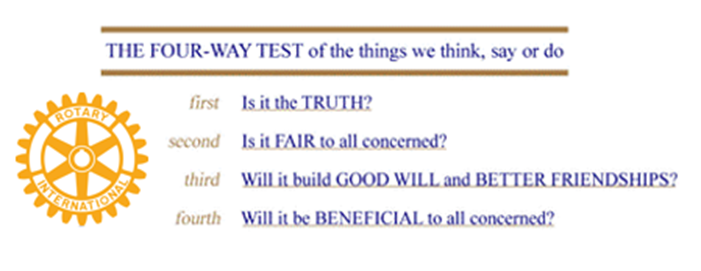
- The Four-Way Test
- Adjournment
Sign up to be a program chair in the new Rotary Year here today!
A Little Dues, A Lot of Good
Supporting District 6900 starts with staying current on your district dues. Keeping your dues up to date ensures we can continue providing leadership development, youth programs, district events, club support, and the many resources that help our clubs thrive.